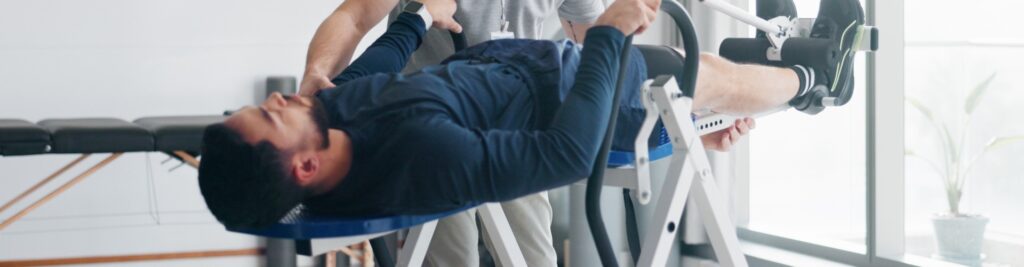














Use Targeted Traction to Reduce Spinal Loading and Improve Movement
Certain neck and lower back problems can make sitting, standing, bending, or staying in one position uncomfortable. For some patients, applying controlled traction to the spine may temporarily reduce symptoms and make it easier to move or participate in rehabilitation. At Meier & Marsh Physical Therapy, spinal decompression in West Valley City, Tooele in Northpointe, Tooele on Main Street and Grantsville, UT is used only when the examination shows that a patient’s symptoms may respond to this type of mechanical treatment. Our physical therapists determine whether traction fits your symptom pattern, select treatment settings for your needs, and use your response to decide whether it deserves a place in your care.
What Is Spinal Decompression?
Spinal decompression is a form of mechanical traction that applies a controlled pulling force to the spine. Depending on the equipment and condition being treated, traction can be directed toward the cervical or lumbar region while the patient rests in a supported position.
The treatment temporarily changes the forces placed on spinal joints and surrounding tissues. It may reduce symptoms for some people with certain neck or lower back conditions, but it should not be presented as permanently putting discs back into place or correcting the structure of the spine.
Your Symptom Response Helps Determine Whether Decompression Fits
An MRI finding or a diagnosis such as a disc problem does not automatically mean spinal decompression is the right treatment. Our physical therapists examine how your symptoms behave with movement and positioning to determine whether traction produces a response that is clinically useful.
Your evaluation may consider:
- Location and behavior of neck or lower back symptoms
- Symptoms that extend into an arm or leg
- Changes in symptoms with repeated movements or positions
- Spinal mobility
- Strength and neurological findings when relevant
- Sensation and reflexes when indicated
- Positions that increase or decrease symptoms
- Tolerance for sitting, standing, or other sustained positions
- Special tests appropriate for the suspected problem
- Medical history and precautions for traction
The pattern matters. If symptoms traveling into an arm or leg change with particular spinal movements or with a trial of traction, that response can help your physical therapist decide whether decompression is worth incorporating into treatment.
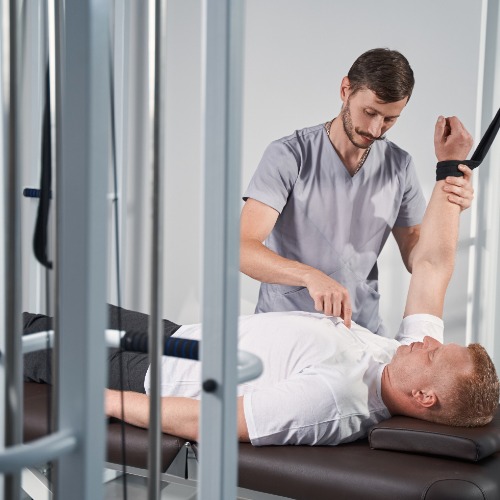
Adjusting Decompression to the Individual Patient
Mechanical traction can be changed according to the spinal region being treated and the patient’s response. Positioning, treatment force, treatment duration, and whether traction is sustained or intermittent may all influence how the treatment feels and how symptoms respond.
Our physical therapists do not rely on one standard decompression setting for every neck or back problem. We monitor what happens during and after treatment, including whether symptoms become less intense, move away from the arm or leg, or allow a previously difficult movement to be performed more comfortably.
Using Symptom Relief to Open the Door to Exercise
Spinal decompression does not rebuild the strength, mobility, or physical capacity needed for everyday life. If traction reduces symptoms, we use that change as an opportunity to address the movements and activities that still need to improve.
A patient whose leg symptoms settle with lumbar decompression may progress into exercises selected according to the directional or movement findings from the examination, followed by strengthening needed for lifting or prolonged standing. Someone receiving cervical traction may work on neck and upper-body movement needed for desk work, reading, or comfortably checking traffic while driving.
Combining Decompression with the Right Physical Therapy
Traction is most useful when its purpose is clear within the larger treatment plan. Depending on the examination, decompression may be combined with specific spinal exercises, progressive strengthening, mobility work, nerve-related movement exercises when appropriate, or training for activities that continue to provoke symptoms.
The combination should reflect how your problem behaves. If a particular movement helps keep leg symptoms closer to the lower back after traction, for example, that movement may become an important part of the rehabilitation plan rather than relying on decompression alone.
Knowing Whether Decompression Is Actually Helping
A comfortable treatment session is not enough to show that spinal decompression is working. Our physical therapists compare your symptoms and movement before and after treatment and monitor whether any improvement carries over into the activities that have been limited.
If traction consistently helps you tolerate sitting longer, move with less difficulty, or participate more fully in exercise, it may remain useful for a period of rehabilitation. If there is no meaningful response, your therapist can redirect treatment instead of continuing decompression simply because a spinal condition is present.
Clinical Reasoning Comes Before the Decompression Table
At Meier & Marsh Physical Therapy, spinal decompression is not prescribed from an imaging report alone. Our physical therapists use clinical expertise, special tests when appropriate, neurological findings, and your response to movement to determine what is limiting you and whether traction addresses a meaningful part of the problem.
We also teach you what your symptoms are telling us and why particular exercises are paired with decompression. The goal is to move beyond temporary unloading and build the movement, strength, and tolerance you need to get back to normal activities.
Frequently Asked Questions
Find Out Whether Your Symptoms Respond to Spinal Decompression
Spinal decompression can be useful for selected neck and lower back problems, but the right patient and the right treatment response matter. A detailed physical therapy assessment can determine whether traction changes your symptoms in a way that supports the rest of your rehabilitation.
Find out whether spinal decompression in West Valley City, Tooele in Northpointe, Tooele on Main Street or Grantsville, UT fits your specific problem at Meier & Marsh Physical Therapy. Our physical therapists can evaluate how your spine and symptoms respond, then prescribe treatment focused on helping you move more comfortably and get back to doing what you love.
Your Next Steps…
- Request An Appointment
- Receive A Custom Treatment Plan
- Work Hard and Progress In Your Recovery
- Recover & Enjoy Life Pain-Free